About Shared Waters
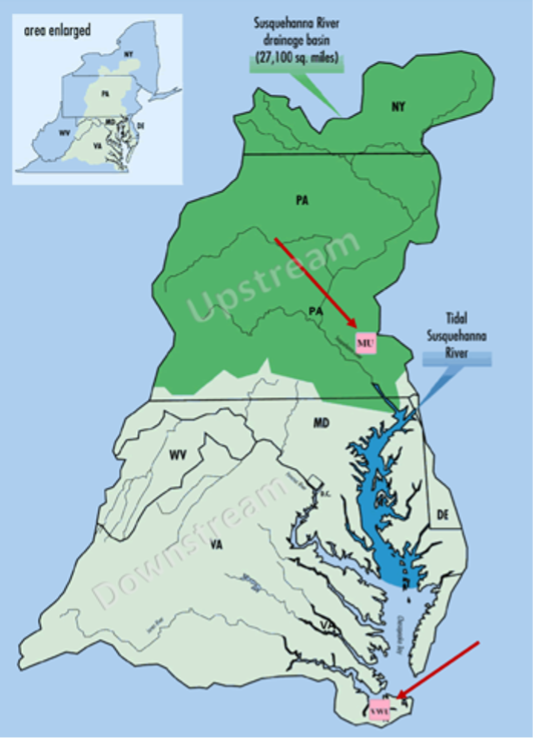
Shared Waters began as a NOAA-funded project, Shared Waters: An Upstream–Downstream Collaborative Project (Award #NA21NMF4570498), bringing together Millersville University of Pennsylvania (MU), Batten University, formerly Virginia Wesleyan University (VWU), Penn Manor School District, and Norfolk Collegiate School. What started as an upstream–downstream partnership has grown into a nationally recognized effort to bring Meaningful Watershed Educational Experiences (MWEE) into classrooms in authentic, engaging ways.
At its core, Shared Waters helps students understand their local watershed and recognize how their everyday actions impact the health of those systems. The project culminated in a comprehensive, classroom-tested elementary curriculum implemented with nearly 1,000 students and embraced by teachers and administrators as a ready-to-use, high-impact resource.
Today, Shared Waters continues to grow.
We now offer two complementary curriculum pathways:
Shared Waters
(Grades 3–5)
Our elementary curriculum includes 10 phenomenon-driven lessons that guide students through understanding watersheds, analyzing water quality, studying macroinvertebrates, and exploring human impacts. The unit culminates in student-driven environmental action, empowering learners to make a difference in their own communities.
This curriculum continues to evolve through a NOAA B-WET grant focused on accessibility and differentiation. The Meaningful and Accessible Environmental Education project (NOAA B-WET Award #NA25NMFX457C0022), led by Virginia Wesleyan University, is developing an enhanced version of the curriculum designed to better support students with learning differences, including students with disabilities, gifted learners, and those from economically disadvantaged backgrounds. These adaptations maintain the integrity of the MWEE experience while ensuring all students can fully engage in the learning and action process.
In addition, the NSF-funded ENVISION project (NSF ITEST Awards #2445736, #2445737, #2445738) is enhancing the elementary experience through the integration of emerging technologies, including augmented reality, interactive models, and career-connected learning experiences. These tools help students visualize complex systems, engage more deeply with data, and see themselves in future STEM and environmental careers.
Salty Streams and Safer Streets
(Grades 6–9)
Our middle school curriculum builds on this foundation by tackling a real-world challenge: balancing road safety with watershed health. Students investigate the impacts of road salt through data analysis, field experiences, and hands-on investigations, ultimately evaluating solutions and making evidence-based decisions about environmental tradeoffs.
This work was supported by the National Oceanic and Atmospheric Administration (NOAA) Pennsylvania Sea Grant College Program (Grant NA24OARX417C0151).
Across all grade levels, Shared Waters is grounded in a simple but powerful goal:
to help students understand their world, care about their local environment, and take informed action.
Funding Acknowledgments
Shared Waters: An Upstream–Downstream Collaborative Project was funded by NOAA Fisheries Habitat Conservation Program Office (NOAA Award #NA21NMF4570498).
Enhancements to the elementary curriculum, including accessibility and differentiation for diverse learners, are supported through a current NOAA B-WET award led by Virginia Wesleyan University (NOAA B-WET Award #NA25NMFX457C0022).
The ENVISION project is supported by the National Science Foundation (NSF ITEST Awards #2445736, #2445737, #2445738).
Shared Waters: Salty Streams and Safer Streets was funded by the National Oceanic and Atmospheric Administration (NOAA) Pennsylvania Sea Grant College Program (NOAA Sea Grant NA24OARX417C0151).
Any opinions, findings, conclusions, or recommendations expressed are those of the authors and do not necessarily reflect the views of NOAA or NSF.