Lesson 8: Salt’s Impact on Ecosystems: Introduction to Macroinvertebrates
In the previous lesson, students investigated the chemistry of their local stream by measuring chloride and, if available, conductivity. Those measurements helped them determine whether road salt may be entering the stream. But chemistry tells only part of the story. Water chemistry provides a snapshot of stream conditions at the moment a sample is collected. To understand the long-term health of a stream, scientists also study the organisms that live there.
In this lesson, students investigate the biological side of stream health by exploring aquatic macroinvertebrates. These small animals—many of which spend months or even years living in streams—reflect water quality over time. Some species are highly sensitive to pollution and environmental change, while others are much more tolerant. Because of these differences, the types of macroinvertebrates living in a stream provide valuable clues about the overall health of the ecosystem.
After it is applied to roads, road salt does not simply disappear. It can move into soils, groundwater, and nearby streams, where repeated exposure to elevated salt levels may stress freshwater organisms that are not adapted to high salinity. Sensitive species may decline, reducing biodiversity and altering the stream food web. Because macroinvertebrates occupy an important place in that food web, changes in their populations can signal broader ecological impacts.
Students begin by exploring how different aquatic organisms are adapted to different salinity levels before investigating the macroinvertebrates living in their local stream. They then identify those organisms using a dichotomous key and evaluate stream health with a biotic index. By combining biological evidence with the chemical data collected in the previous lesson, students develop a more complete picture of watershed health.
Teacher Tip: Preparing for the Macroinvertebrate Investigation
This lesson uses the Leaf Pack Network protocol developed by Stroud Water Research Center. Before teaching the lesson, review the Leaf Pack Network Manual, paying particular attention to the sections on Where to Sample, Placing Leaf Packs, Collecting Leaf Packs, and Sorting and Identification.
Leaf packs should be deployed in the stream 3–4 weeks before this lesson to allow aquatic macroinvertebrates to colonize them. The investigation can be completed either at the stream or in the classroom. If working in the classroom, collect the leaf packs on the morning of the lesson and transport them in a 5-gallon bucket filled with stream water. Keep the bucket cool and out of direct sunlight and, if possible, use an aquarium bubbler or air pump to maintain dissolved oxygen.
Macroinvertebrates breathe underwater—keep the leaf packs submerged in stream water before, during, and after the investigation. Return all live organisms to the stream within 24 hours of collection.
If students will not visit the collection site, consider taking a few photographs of the stream and surrounding habitat to share during the lesson. Seeing the stream where the organisms were collected helps students connect the macroinvertebrates they identify to the larger watershed they are investigating.
Materials:
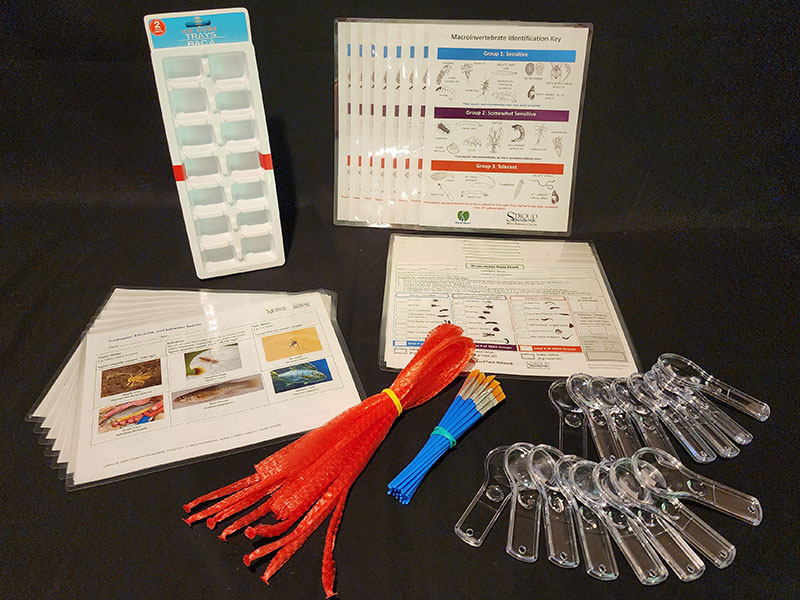
Materials provided in the :
- Activity 1: Student handout: Freshwater, Estuarine, and Saltwater Species 8 Laminated copies, 1/group
- Activity 3: Leaf Pack Experiment
- 8 Mesh bags
- 8 white ice cube trays
- 16 paint brushes
- 16 magnifying lens
- 8 laminated Bioindices data sheet
- 8 laminated Macroinvertebrate Identification Dichotomous Key
- Plastic spoons (reuse from Lesson 7)
Materials you will need to gather:
- Lesson Slides
- Activity 1: Video: https://whyy.org/episodes/america-suburbs-alopecia-salt-snow-philadelphia/ (begin 9:25, end 15:45)
- Activity 2: Leaf Pack Simulation® from the Leaf Pack Network®
- Activity 3: Plastic wash basins or large bowls for sorting
- Activity 3: Dried leaves from native and local tree species
Optional: For teachers interested in expanding their macroinvertebrate studies, the Leaf Pack Kit® (LaMotte Company) provides a complete set of leaf pack and sorting materials. Additional identification resources are available from Stroud Water Research Center, including Macroinvertebrate Identification Dichotomous Keys, the children’s book Creek Critters, and the Stream Bug Scavenger Hunt Fundana.
Pennsylvania Teachers — Legal Requirements: Please review all local and state laws regarding the collection of macroinvertebrates. Pennsylvania teachers will need a valid fishing license and a Type IV Special Permit Educational Exemption to Fishing License.
Learning Objectives:
At the completion of this lesson, students will be able to:
- Interpret graphs and understand the survival rates of different species in the presence of chloride in the water. STEELS Standard(s): 3.4.6-8.E, 3.1.6-8.S
- Apply scientific knowledge and graphical analysis to extrapolate the impacts of humans on the environment, specifically as they relate to stream life. STEELS Standard(s): 3.1.6-8.L, 3.3.6-8.C
- Identify aquatic macroinvertebrates. STEELS Standard(s): 3.3.6-8.M, 3.4.6-8.E
- Assess the health of a river in their watershed using a biotic index for aquatic macroinvertebrates. STEELS Standard(s): 3.1.6-8.L, 3.3.6-8.M, 3.4.6-8.C
Activities:
In the previous lesson, students investigated how conductivity and chloride can reveal the presence of road salt in streams. This warm-up activity shifts the focus from the chemistry of the water to the organisms that live in it. Students begin by comparing three aquatic ecosystems—freshwater, estuaries, and saltwater—to discover that different organisms are adapted to different levels of salinity. This provides the foundation for understanding why increasing salt concentrations can affect freshwater organisms and why macroinvertebrates are valuable indicators of stream health.
Freshwater, Estuaries, and Oceans
Distribute the Freshwater, Estuarine, and Saltwater Species fact sheet showing freshwater, estuarine, and marine ecosystems. Ask students to compare the organisms that live in each environment and the typical specific conductance of each type of water.
Guide students to consider:
- What differences do you notice among these three aquatic environments?
- Why do you think different organisms live in each one?
- Can some organisms survive in more than one environment?
- What might happen if a freshwater organism were placed in saltwater?
Explain that every aquatic organism has a range of salinity it can tolerate. As salt concentrations increase, some organisms become stressed or are no longer able to survive. This idea provides the foundation for understanding how road salt can affect freshwater ecosystems.
Interview with a Scientist
After exploring the fact sheet, students will hear from Dr. John Jackson, Senior Research Scientist at Stroud Water Research Center, who explains how increasing salt concentrations affect freshwater streams. Play the interview (9:25–15:45) and encourage students to listen for evidence that road salt can change not only the chemistry of a stream, but also the organisms that live there.
After the interview, discuss:
- Why might freshwater organisms be affected by increasing salinity?
- Would all organisms respond the same way to salt?
- If chemistry provides a snapshot of stream health, what might living organisms tell us?
What Are Aquatic Benthic Macroinvertebrates?
Introduce the term aquatic benthic macroinvertebrate by breaking it into its four parts:
- Aquatic – lives in water
- Benthic – lives on or near the bottom of a stream or river
- Macro – large enough to see without a microscope
- Invertebrate – an animal without a backbone
Most aquatic macroinvertebrates are immature insects that spend months or even years living in freshwater before becoming adults. Because they remain in the same stream for much of their lives, they experience changes in water quality over time. Macroinvertebrates are one group of organisms that are particularly sensitive to increases in salinity. While some species can tolerate elevated salt concentrations, others cannot. As a result, the types of macroinvertebrates living in a stream provide valuable evidence about its long-term health.
Macroinvertebrates are also an important part of the freshwater food web, providing food for fish, amphibians, birds, and other wildlife. When road salt or other pollutants reduce populations of sensitive macroinvertebrates, the effects can ripple throughout the ecosystem. In the next two activities, students will become stream ecologists, identifying aquatic macroinvertebrates and using them as biological indicators to evaluate the health of their local stream.
Students now shift from learning why macroinvertebrates are useful indicators of stream health to learning how scientists identify them. Using the Leaf Pack Simulation, students practice identifying common aquatic macroinvertebrates and calculating a Pollution Tolerance Index (PTI) before working with live organisms in the next activity.
Working individually or with a partner, have students visit the Leaf Pack Simulation and select Stream A. Begin with the Habitat tab and use the stream photograph to answer the habitat questions. Then select the Macroinvertebrates tab to complete the virtual investigation. Students will deploy a leaf pack, sort and identify the collected macroinvertebrates, and calculate the stream’s PTI score.
Encourage students to discuss how the types of macroinvertebrates they found influenced the PTI score. Explain that they will use these same identification skills in the next activity when they investigate macroinvertebrates collected from a local stream.
Students now apply the skills they practiced in the simulation to a real stream investigation. Using leaf packs collected from a local stream, they will identify aquatic macroinvertebrates and use a Pollution Tolerance Index (PTI) to evaluate the stream’s biological health. What looks like a simple bag of leaves is actually a tiny stream habitat—after just 3–4 weeks underwater, the leaf pack becomes colonized by a remarkable variety of organisms. This makes leaf packs an effective way for scientists to sample stream life and allows students to connect biological evidence with the chemical evidence from the previous lesson.
Making a Prediction
Before students begin, ask them to predict the health of the stream. Based on what they have learned so far, do they expect the stream to be Poor, Fair, Good, or Excellent? Encourage students to explain the evidence behind their prediction. Remind them that pollution-sensitive macroinvertebrates contribute more points to the PTI than pollution-tolerant species, so streams with a greater diversity of sensitive organisms generally receive higher scores.
Investigating the Leaf Pack
Working in small groups, provide each group with a leaf pack, a shallow sorting tub, an ice cube tray, stream water, hand lenses, paintbrushes, spoons, a Macroinvertebrate Identification Dichotomous Key, and a Biotic Index Data Sheet. Add stream water to both the sorting tub and the ice cube tray before students begin. Place a small handful of leaves into the sorting tub and remind students to keep both the leaves and macroinvertebrates submerged throughout the investigation.
Students should carefully examine the leaves and gently remove each macroinvertebrate using a paintbrush or spoon. As organisms are found, place them into separate compartments of the ice cube tray, grouping together organisms that appear to be the same type. White ice cube trays make the organisms much easier to see and compare.
Once students have sorted the organisms, they should use the Dichotomous Key to identify each type and record the number of each on the Biotic Index Data Sheet. After all groups have completed their identifications, combine the class data to calculate the stream’s overall PTI and determine whether the stream’s biological health is Excellent, Good, Fair, or Poor.
Making Sense of the Evidence
Bring the class together to discuss the results:
- Did the biological evidence support your original prediction?
- How did the biological assessment compare with the conductivity and chloride data collected in the previous lesson?
- What does combining chemical and biological evidence tell us that either one alone cannot?
A Scientist’s Challenge
Present students with the following scenario:
Suppose the chemistry data suggested the stream was healthy, but the macroinvertebrates suggested it was unhealthy. What questions would you investigate next?
Allow students time to discuss possible explanations. They may suggest that water quality has changed over time, that pollution occurred before sampling, that another pollutant besides road salt is affecting the stream, or that additional data should be collected. Emphasize that scientists rarely rely on a single measurement when evaluating ecosystem health—they combine multiple lines of evidence, ask new questions, and collect additional data before drawing conclusions.
Teacher Tip: Students do not need to identify every macroinvertebrate perfectly to successfully complete this investigation. Encourage them to use the dichotomous key carefully and to make evidence-based decisions. Because the class combines data from multiple groups, a few identification errors will have little effect on the overall PTI.
Adaptations & Extensions:
Extension 1: Outdoor Field Experience
Ideally, conduct your macroinvertebrate identification activity streamside with your students. If you take the class to the stream, you can also include a physical stream assessment—a great tool that provides a third way to assess stream health.
Extension 2: Site-to-Site Comparisons
Take macroinvertebrate samples at different points along the stream—such as upstream and downstream locations—and perform the same tests. Other ideas include studying a stream that flows into the waterbody you’re studying, the river your stream flows into, the outflow of a lake or reservoir, downstream of a golf course or other major land use, or downstream from a major city or town.
Extension 3: Community Science and Shared Data
Participate in a community science project and share the class’s data by joining the Leaf Pack Network®, an international network of teachers, students, and citizen monitors investigating their local stream ecosystems. To join, sign up online and follow the instructions in the Leaf Pack Network Manual for preparation, placement, and collection of your leaf packs.
Assessment:
Students demonstrate their understanding throughout the lesson by correctly using the Macroinvertebrate Identification Dichotomous Key, completing the Biotic Index Data Sheet, calculating the Pollution Tolerance Index (PTI), and interpreting the results.
Conclude the lesson with the Scientist’s Challenge in Activity 3. Students should use evidence from both the chemical investigation in Lesson 7 and the biological investigation in this lesson to explain why scientists rely on multiple lines of evidence when evaluating stream health.