Lesson 9: Culminating Activity, Synthesis of Data
This is the lesson where the rubber meets the road -Mr. Showalter 4th grade teacher.
Throughout this unit, students have explored their watershed from many different perspectives. They investigated how water moves across the landscape, modeled runoff, engineered water filters, tested stream chemistry, and examined aquatic macroinvertebrates. Each investigation provided one piece of a much larger puzzle.
Now it is time to step back and ask: What story does all of our evidence tell about the health of our watershed?
This is the moment when everything comes together. Rather than viewing each investigation as a separate activity, students synthesize evidence from across the unit to construct an explanation about the health of their local watershed. They identify patterns, make connections across investigations, and explain cause-and-effect relationships using evidence collected throughout the unit. This is the work of environmental scientists.
Scientists rarely base conclusions on a single investigation. Instead, they gather many different kinds of evidence, compare patterns, discuss competing explanations, and refine their understanding as new information becomes available. In this lesson, students engage in that same process as they develop an evidence-based explanation of the health of their watershed. Their explanation becomes the scientific foundation for Lesson 10, where they will design an action project to help protect and improve their local watershed.
Materials:
Materials provided in the Lesson 9 kit:
- Activity 1: n/a
- Activity 2: n/a
Materials you will need to gather:
- Lesson 9 slide show
- Activity 1 and 2: Making Sense of Our Watershed Evidence Handout
Learning Objectives:
At the completion of the lesson, students will be able to:
At the completion of the lesson, students will be able to:
- Analyze evidence from multiple investigations to identify patterns, relationships, and possible contradictions.
- Construct a Claim-Evidence-Reasoning explanation about the health of the local watershed.
- Evaluate whether the available evidence supports, challenges, or leaves uncertainty in an explanation.
Activities:
This is the moment when students bring the entire unit together. Over the past several weeks, they have explored their watershed from many different perspectives. They investigated how water moves through the environment, examined how people influence the watershed, and collected evidence about the health of a local stream. Each investigation provided one piece of a much larger puzzle.
Today, students step back and ask an important scientific question: What story does all of our evidence tell about the health of our watershed?
Emphasize that scientists organize evidence into categories before looking for patterns, identifying connections, and developing explanations. Throughout the unit, students have collected evidence that helps answer three important questions about their watershed:
- How does water move through our watershed?
- How do people affect the watershed?
- How healthy is our local stream?
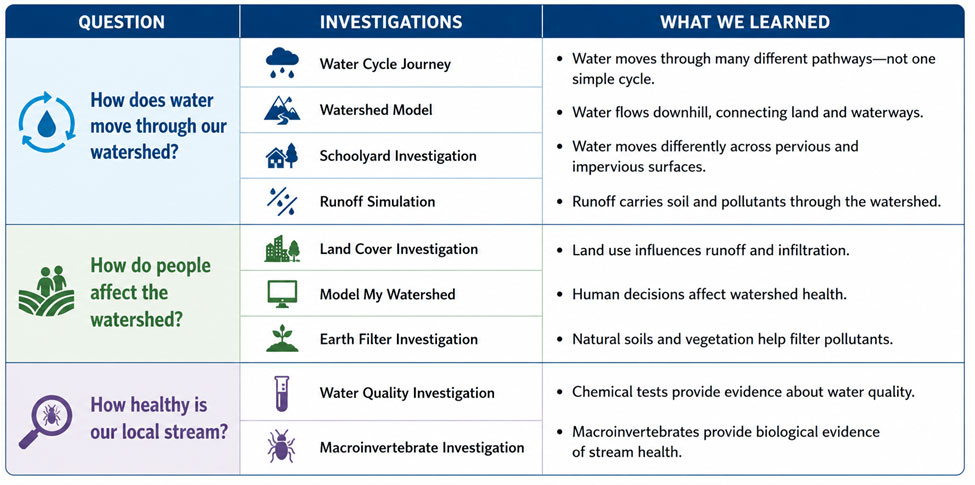
Return each group’s completed Making Sense of Our Watershed Evidence Handout and display the Organizing Our Evidence slide. Ask groups to review the three blocks they completed during Lessons 4, 6, and 8. Give them time to revise or add to their earlier thinking before completing the Looking Across All of the Evidence and biggest message sections of the organizer. As students work, listen carefully to their conversations. Encourage them to support their thinking with evidence from multiple investigations rather than relying on a single activity. When groups become focused on one lesson, prompt them to look across the unit by asking questions such as:
- What other investigation supports that idea?
- Did you collect any evidence that connects to this?
- Does any evidence challenge your thinking?
- What patterns or connections are beginning to emerge?
Resist the urge to steer students toward a particular conclusion. Instead, encourage them to justify their thinking using evidence from the investigations. Different groups may identify different patterns or reach different interpretations, and that is a natural part of scientific sensemaking.
The purpose of this activity is to help students organize their thinking and recognize patterns and connections across the unit. Students should leave this activity with a clearer understanding of the story their evidence is beginning to tell. In Activity 2, they will use this thinking to construct a Claim-Evidence-Reasoning (CER) explanation supported by evidence from multiple investigations.
Now that students have organized the evidence from across the unit, they are ready to construct an explanation about the health of their watershed. Scientists do more than collect data, they use evidence to explain what they think is happening and why. In this activity, students communicate their thinking using a Claim-Evidence-Reasoning (CER) framework.
Remind students that scientific explanations are built from evidence rather than opinions. Different groups may develop different claims, especially when the evidence is complex or incomplete. The goal is not for every group to reach the same conclusion, but for every explanation to be supported by evidence and sound reasoning.
Using page 2 of the Making Sense of Our Watershed Evidence Handout, give groups time to discuss the message they identified during Activity 1. Encourage students to begin by revisiting the biggest message they identified during Activity 1. Then, guide them in refining that idea into a scientific claim before selecting the strongest evidence to support it. As students work, circulate through the room, listening carefully to their conversations. Rather than confirming whether a claim is correct, ask questions that encourage students to strengthen their explanations.
- Which investigations provide the strongest evidence for your claim?
- Does another investigation support that same idea?
- How do these pieces of evidence fit together?
- Is there any evidence that challenges your explanation?
Students often find the reasoning section the most challenging because it requires them to explain why their evidence supports their claim. Encourage them to think about cause-and-effect relationships within the watershed system rather than simply restating their evidence.
When groups have completed their CER, invite each team to share its explanation with the class. As students listen to one another, encourage them to compare the evidence and reasoning used by different groups. Although groups may reach different conclusions, they should recognize that strong scientific explanations are grounded in evidence collected through investigation.
Conclude by reminding students that environmental scientists use evidence-based explanations to inform decisions about protecting natural resources. In the next lesson, students will use the explanation they developed today as the foundation for designing an action plan to help their watershed.
Possible Differentiation Adaptations:
Some groups may need additional support identifying patterns and connections across multiple investigations. Rather than asking students to analyze all of the evidence at once, narrow their focus to two or three related data sources. For example, students might compare observations from the Schoolyard Investigation with their Water Quality data or connect findings from the Land Cover Investigation to their Macroinvertebrate Investigation. Limiting the amount of data allows students to practice making evidence-based connections without becoming overwhelmed. As students gain confidence, encourage them to expand their thinking by incorporating evidence from additional investigations into their explanation.
Assessment:
- Explain one connection you found between two or more investigations.
- Construct an evidence-based explanation about the health of your watershed using evidence from multiple investigations.